Success Story
Empowering Change: The Inspiring Journey of Mrs. Reshma Tharu
Mrs. ReshmaTharu, a is 27 years old, resides with her family of five in Dashgharwa Tole in the Model village, Ward No 10 of the Barbardiya Municipality, Bardiya District, Nepal. Her family belongs to the Kamaiya community and owns 5 kattha (approximately 0,17 acres) of land for their home. Due to their poor economic hardship, they rely on others’ fields for farming to sustain their livelihood.
The family faces significant agricultural challenges due to the adequate irrigation and water resources, making their land entirely dependent on natural rainfall. This dependence severely impacts their ability to properly harvest both seasonal and off-season vegetables and fruits, contributing to their deep-rooted poverty.
Past experience and Challenges: As she belongs to the Freed Kamaiya family has faced significant hardships in raising her children due to their limited property, extreme poverty and lack of financial resources. It was difficult for her to afford the school essentials such as school uniforms, bags and stationery.
Both husband and wife collect vegetable from the farmers and sell them at the weekly market. However, the income from this work is low. It is just enough to cover basic day to day expenses such as groceries, utensils, clothes for the children, and medicine. Due to their poor financial condition, the community people did not believe in their potential and often unwilling to provide any financial assistance.
Actual situation and changes: When the “Improve Quality of Life and Sustainable Development Project” was launched, in support of this initiative, Community Partners International (CPI) and Woman and Child Development Organization (WACD) Nepal began providing technical and financial support to develop a Model Village.
The Woman and Child Development (WACD) Nepal has formed the Dashgharwa Women’s Group 19 June 2023 and Mrs. Reshma Tharu, was nominated as group member. The WACD Nepal has been actively involved in providing training programs to the group members including program introduction and orientation, micro-enterprise, healthy home healthy garden and community-based health care services.
The Dashgharwa Women’s Group received financial assistance of NPR 50,000 (USAD 378) from WACD Nepal as seed money to support the group’s mobilization and management.
After receiving the training, Reshma Tharu was motivated to take a loan from the seed fund and started small scale vegetable farming by leasing 7 kattha of farmland. WACD Nepal is providing ongoing technical guidance to Mrs. Tharu, ensuring her success in sustainable agriculture. This support includes expert advice on: Nursery development, Herbal compost preparation, Organic pesticide formulation and Methods for harvesting both seasonal and off-season vegetables.
This initiative highlights WACD Nepal’s commitment to empowering women through financial support and capacity building, fostering self-sufficiency and sustainable livelihoods within the community.
From August and November 2023, Reshma Tharu earned NRs 1, 50,000/ (USD.1,136.00) through seasonal and off seasonal vegetable farming. With this income, she was able to lease an additional 8 kattha of land for cultivation. This makes marks significant achievement for Reshma and her family, reflecting the positive impact of the project and her dedication.
Reshma Tharu shared that her entire family is now very happy and actively supports her in the farming work. These days, they sell their vegetables in the wholesale market, and because their produce is organic, it fetches a better price compared to other vegetables.
However, she also mentioned that irrigation and water scarcity continue to be major challenges in vegetable cultivation. Despite this, Reshma is now able to manage her family’s basic needs, including paying school tuition fees, buying school uniforms, and purchasing stationery with ease.
Reshma Tharu expressed her heartfelt gratitude to WACD Nepal and CPI for their financial and technical support, which she says opened her eyes to the possibility of starting a business. She shared that her family is now mentally free from economic burdens and is experiencing joy and hope in their daily lives.
Her success has become a source of inspiration for the entire community. Many are now motivated to start their own businesses, and the group members are even dreaming of launching a joint entrepreneurial venture in the Model Village of Dashgharawa Tole.
As the first woman in the village to start a business, Reshma has become a role model for other women in the group and the broader community. Potential business ideas in the area include: Bamboo products, Duna Tapari (leaf plates), Seasonal and off-seasonal vegetable farming, Pig and goat farming & Home gardening.
She expresses her heartfelt gratitude to WACD Nepal and Community Partners International (CPI) for their financial and technical support, which opened her eyes to the possibility of starting a business. Today, her family feels mentally free from economic burdens and enjoys a better quality of life. Her success has inspired the entire community, encouraging others to pursue their own business ventures. Motivated by her achievements, the group members are now envisioning the launch of a joint entrepreneurial initiative in the Model Village of Dashgharawa Toll. As the first woman in the village to establish a business, she has become a role model for other women in the community. Potential business ideas in the area include bamboo products, Duna Tapari, seasonal and off-seasonal vegetable farming, pig and goat rearing, and gardening.Recommendations and Suggestions: The Healthy Home, Healthy Garden training has motivated us to regularly grow organic vegetables and maintain cleanliness in our homes, kitchens, public spaces, and roads. This initiative has brought positive energy and improved daily living conditions. She strongly recommends the continuation of this project and urges that similar opportunities be extended to other women in the community. Supporting women to increase their income through diverse livelihood options will contribute to sustainable development and help transform the area into a true Model Village in Bardiya District.
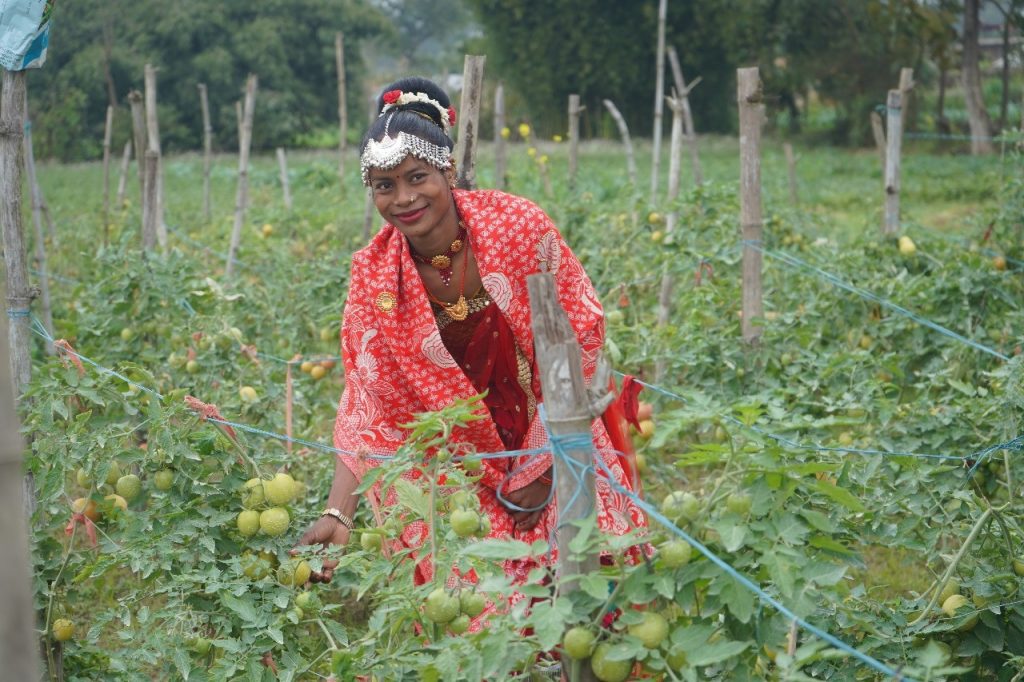
Reshma Tharu in her field with organic tomato